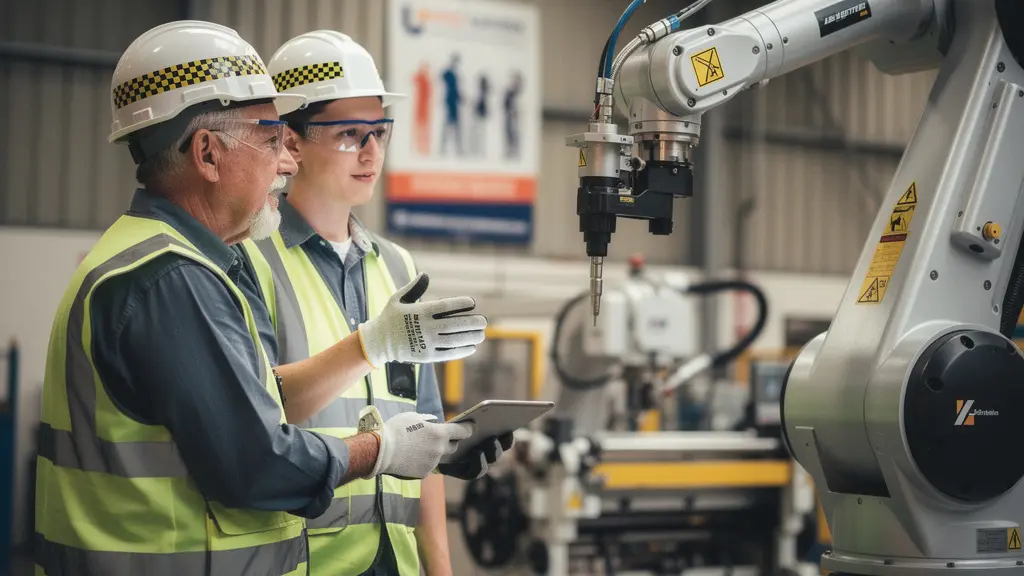
The common belief that unions are a barrier to AI integration is a strategic miscalculation; they are your most critical asset for de-risking the process.
- Successful AI adoption hinges not on top-down mandates, but on joint governance frameworks co-created with union representatives from day one.
- ROI must be redefined beyond productivity, using ‘Just Transition’ metrics that track worker well-being, skills development, and safety improvements.
Recommendation: Shift from a ‘consultation’ mindset to a ‘co-creation’ strategy. Your first step is not to select the technology, but to establish a joint management-union ‘Future of Work’ committee.
For any factory manager in the UK, the push for digital transformation feels relentless. The promise of AI—from predictive maintenance to automated quality control—is immense, but so is the spectre of industrial action. The default approach often involves meticulous planning behind closed doors, followed by a ‘big reveal’ to the workforce and their union reps, hoping to manage the inevitable backlash. This strategy is fundamentally flawed and treats your workforce’s representatives as an obstacle to be overcome, rather than a partner in innovation.
The conversation around AI and labour is often dominated by platitudes about ‘communication’ and ‘transparency’. While important, these concepts are passive. They don’t address the core anxieties on the factory floor: job security, de-skilling, and algorithmic surveillance. The fear isn’t just about job losses; it’s about the loss of autonomy and dignity in work. Trying to push technology through this wall of legitimate concern is a recipe for stalled pilots, low morale, and costly disputes.
But what if the entire premise was inverted? What if, instead of planning *for* the union, you planned *with* them? The true key to unlocking AI’s potential in a unionised UK manufacturing environment is not about perfecting your pitch; it’s about establishing genuine partnership through joint governance and co-creation. This isn’t a compromise; it’s a powerful strategic tool to de-risk technology deployment, accelerate adoption, and build a more resilient, skilled, and engaged workforce. It transforms the process from a confrontation into a shared project with mutual goals.
This guide provides a practical framework for this new approach. We will explore how to tackle the skills gap using reformed government levies, establish robust data privacy frameworks that build trust, escape the dreaded ‘pilot hell’ by ensuring worker buy-in, and measure success with metrics that reflect a just transition. This is your playbook for turning a potential point of conflict into your greatest competitive advantage.
This article outlines a strategic path forward, detailing how to transform potential friction into a powerful engine for change. The following sections provide a comprehensive guide to navigating this complex but rewarding journey.
Summary: A Factory Manager’s Guide to AI and Union Partnership
- Why Your Current Workforce Cannot Support Your Digital Transformation?
- How to Utilize the Apprenticeship Levy for Tech Upskilling?
- Proprietary Software vs Open Source: What Suits UK Data Privacy Laws?
- The ‘Pilot Hell’ Trap That Stalls Innovation for Years
- How to Measure the Productivity Gain of AI Tools Within 6 Months?
- How to Retrofit Flexibility into Rigid Legacy Operations by Q3?
- Why Traditional Forecasting Fails During UK Weather Extremes?
- How to Use Machine Learning to Reduce Inventory Waste in Perishable Supply Chains?
Why Your Current Workforce Cannot Support Your Digital Transformation?
The single greatest barrier to your digital transformation isn’t technology or capital; it’s the widening chasm between the skills your operation needs and the skills your workforce currently possesses. The reality is that without a proactive, large-scale upskilling strategy, your existing team lacks the foundational digital literacy and specific AI competencies to effectively operate, maintain, and innovate with new systems. This isn’t a criticism of your employees; it’s a systemic failure that leaves your business vulnerable and your workforce anxious about its future.
This skills gap is not a future problem; it’s a present-day crisis. Relying on hiring external talent is an expensive, short-term fix that often breeds resentment among long-serving staff. It also ignores the deep institutional knowledge your current employees hold—knowledge that is vital for successfully integrating new technology into existing workflows. The challenge is compounded by a national trend where mechanisms designed to fund training are being underutilised. For instance, recent employment data reveals a worrying trend in adjacent sectors, and this pattern of underinvestment in skills is a red flag for all UK industries, including manufacturing.
Ignoring this gap creates a vicious cycle. Without the right skills, AI projects are more likely to fail, reinforcing the belief that the technology is not viable. This, in turn, fuels job security fears and strengthens opposition to future initiatives. Unions see this ‘deskilling’ as a direct threat, leading to a defensive posture that makes any form of collaboration difficult. The first step towards a successful AI strategy is therefore not a technology roadmap, but a brutally honest workforce skills assessment conducted in partnership with union learning representatives. You cannot build a smart factory with a workforce that has been left behind.
How to Utilize the Apprenticeship Levy for Tech Upskilling?
The skills gap is not an insurmountable problem; it’s a funding and strategy challenge. For UK manufacturers paying into the Apprenticeship Levy, a significant—and often underused—pool of capital is available specifically for workforce development. Historically, the levy’s rigid structure made it difficult to apply to the kind of agile, tech-focused training required for AI. However, significant reforms are changing the game, transforming the levy from a bureaucratic burden into a strategic war chest for upskilling.
The transition to the new Growth and Skills Levy in 2025 is a critical opportunity. This reform directly addresses the needs of digital transformation by allowing up to 50% of the funds to be spent on non-apprenticeship training, including shorter, modular courses in areas like data analytics, machine learning operation, and AI ethics. This flexibility allows you to rapidly retrain existing employees for new roles, demonstrating a clear commitment to your current workforce’s future. The potential is enormous; some sectors have already seen an extraordinary 420% increase in technical apprenticeship postings by strategically aligning levy use with emerging skill demands.
To leverage this effectively, factory managers must work with HR and union reps to map future skills needs to the new, flexible training options available under the reformed levy. The following table breaks down the key changes that the upcoming Growth & Skills Levy introduces, offering a clear advantage for proactive businesses.
| Feature | Traditional Levy (Pre-2025) | Growth & Skills Levy (2025+) |
|---|---|---|
| Fund Usage | Apprenticeships only | 50% apprenticeships, 50% flexible training |
| Training Options | Full apprenticeships | Short courses, AI upskilling, modular programmes |
| Fund Expiry | 24 months | 12 months |
| SME Support | 5% co-investment required | Fully funded for under-25s from 2026 |
| Administrative Burden | Complex application process | Streamlined for smaller businesses |
The message to your workforce is powerful: we are not replacing you; we are investing in you. By co-designing a skills plan with union partners and funding it through the levy, you reframe upskilling as a shared objective, not a top-down mandate. This builds the trust necessary to move forward with technology implementation, turning skills development into the first pillar of your collaborative AI strategy.
Proprietary Software vs Open Source: What Suits UK Data Privacy Laws?
Once skills are being addressed, the next major hurdle is data. The introduction of AI, particularly for quality control or performance monitoring, inevitably involves collecting and processing vast amounts of new data—data about your processes, and potentially, your people. This is a minefield of privacy concerns governed by UK GDPR and a key point of contention for unions. The choice between proprietary (black box) and open-source AI solutions is therefore not just a technical decision; it is a critical choice about transparency and trust.
The core of the issue is that the regulatory landscape is struggling to keep up with the pace of innovation. As the Trades Union Congress (TUC) powerfully stated in their legislative proposal, the current framework is often inadequate. In a paper proposing new legislation, the Trades Union Congress notes that “UK employment law is simply failing to keep pace with the rapid speed of technological change”.
UK employment law is simply failing to keep pace with the rapid speed of technological change
– Trades Union Congress, TUC AI Employment and Regulation Bill Proposal
This regulatory lag creates a vacuum that proprietary software can exacerbate. ‘Black box’ algorithms, where the logic is hidden, make it impossible to explain *why* a decision was made. This is unacceptable in a unionised environment where the right to a fair and transparent process is paramount. Open-source solutions, while potentially more complex to implement, offer a crucial advantage: auditability. The ability to inspect the code and understand the logic is a powerful trust-building mechanism. It allows for joint management-union technical committees to verify that algorithms are not biased and are operating within agreed-upon parameters.

The most robust solution is to move beyond the software choice and establish a Joint Data Trust Framework. This is a formal agreement, co-created with union reps, that defines what data is collected, for what purpose, who can access it, and how decisions can be appealed. It institutionalises the principles of data privacy and fairness, making them part of the factory’s operational DNA. This proactive governance is the only sustainable way to navigate the complexities of AI and data in the workplace.
Your Action Plan: Implementing a Joint Data Trust Framework
- Establish joint management-union data governance committee with equal voting rights
- Define transparent data collection boundaries aligned with ICO guidelines
- Create worker consent protocols for special category data (biometric, health, union membership)
- Implement regular audits with union observer participation
- Develop clear escalation procedures for data protection violations
The ‘Pilot Hell’ Trap That Stalls Innovation for Years
Many promising AI initiatives die a slow death in “pilot hell.” A project is launched in a controlled corner of the factory, shows some initial success, but never scales. It remains a permanent ‘pilot’, starved of resources and wider buy-in, eventually fading into obscurity. One of the primary causes of this phenomenon is a failure to secure genuine workforce and union support from the very beginning. A pilot perceived as a top-down experiment, or worse, a secret trial to automate jobs, will be met with passive resistance, data contamination, or outright opposition, guaranteeing its failure.
The solution is to reframe the pilot not as a test of technology, but as a collaborative experiment in workplace evolution. This means involving union representatives and selected workers in the design phase, not just the testing phase. They can provide invaluable ground-truth insights that make the technology more effective and ensure the pilot’s objectives align with worker interests as well as business goals. This approach of ‘co-creation’ turns critics into champions. When workers feel a sense of ownership over the new system, they are motivated to make it succeed.
Case Study: Microsoft’s Proactive Union Engagement Model
A landmark example of escaping pilot hell comes from outside manufacturing but offers a universal lesson. Microsoft’s 2024 collective agreement with the Communications Workers of America requires the company to proactively inform unions whenever AI implementation ‘may impact work performed’. According to an analysis by the World Economic Forum, this early-stage consultation model prevents pilot stagnation by building worker buy-in from the concept stage. It demonstrates that engaging unions as partners, not adversaries, is a direct accelerator for successful AI deployment.
The data on this is compelling. Research shows a dramatic difference in outcomes when technology is implemented with, versus against, the workforce. One study found that union-supported workplace technology implementations have a success rate of over 80%, compared to a much lower figure for those pushed through without support. This isn’t about appeasement; it’s about smart risk management. Engaging the union early is the single most effective way to ensure your pilot has the social license to operate, scale, and deliver real value to the business.
How to Measure the Productivity Gain of AI Tools Within 6 Months?
The pressure to demonstrate a return on investment for any AI project is intense, and a six-month timeframe is ambitious. The traditional approach focuses narrowly on metrics like Overall Equipment Effectiveness (OEE), cost per unit, and cycle time. While important, these figures tell only half the story. In a unionised environment, measuring success solely on these terms can be counterproductive, as it can be perceived as valuing machine efficiency over human well-being, thus fuelling opposition.
A more strategic approach is to adopt a Balanced Scorecard for a ‘Just Transition’. This means expanding your definition of ROI to include metrics that matter to your workforce and their representatives. Alongside OEE, you should be tracking improvements in workplace safety (e.g., RIDDOR incident reduction), increases in employee skills (e.g., certification completions), and boosts in job satisfaction (e.g., worker well-being scores). Presenting a dashboard that shows AI is not only cutting costs but also creating a safer, more skilled, and more rewarding workplace is an incredibly powerful argument that builds bridges with unions.
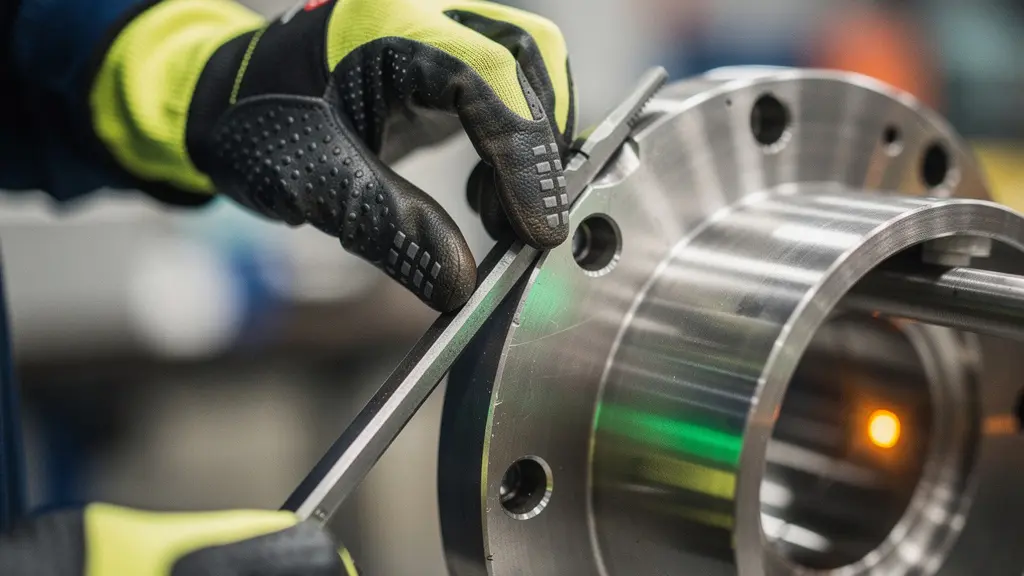
This doesn’t mean ignoring hard productivity numbers. AI’s impact here can be significant and swift. For instance, techUK’s research highlights that predictive maintenance driven by AI can deliver a 30% reduction in unplanned downtime within the first year. The key is to present this data alongside the ‘just transition’ metrics, creating a holistic picture of value. The following table provides a model for this balanced approach.
| Traditional Metrics | Just Transition Metrics | Measurement Method |
|---|---|---|
| Overall Equipment Effectiveness (OEE) | RIDDOR incident reduction rate | Monthly safety reports comparison |
| Production output volume | Internal promotions to tech roles | HR advancement tracking |
| Cost per unit | Employee retention rate | Quarterly workforce stability index |
| Cycle time reduction | Skills certification completion | Training programme participation |
| Defect rates | Worker wellbeing scores | Anonymous quarterly surveys |
By measuring what matters to your people, you prove that technology adoption is not a zero-sum game. You demonstrate that productivity and people can, and must, advance together. This shared definition of success is the ultimate foundation for a lasting partnership.
How to Retrofit Flexibility into Rigid Legacy Operations by Q3?
One of the biggest challenges in UK manufacturing is dealing with rigid, legacy operations and machinery. The idea of integrating fluid, AI-driven processes can seem impossible. However, the goal is not to rip and replace, but to retrofit flexibility by intelligently augmenting human roles with AI support. This is where human-AI collaboration moves from a concept to a factory-floor reality, creating a more agile and resilient operation without massive capital expenditure.
Consider a fixed production line. During a changeover, skilled operators might typically be idle. An AI-driven system can predict changeover times with greater accuracy, allowing those same operators to be proactively retasked to other value-adding activities, such as quality control, material preparation for the next run, or even short training modules. This is not ‘deskilling’; it is skill diversification. It transforms downtime into productive time and makes the entire operation more elastic. A recent UK academic research hub highlighted a case where a food manufacturer successfully reframed this exact process as a ‘deskilling prevention’ strategy, which allowed them to gain full union support for the initiative.
This approach directly enhances operational flexibility and resilience, a critical concern for UK supply chains. A 2025 study of UK manufacturers provided strong evidence for this, finding that 57.8% of UK supply chain managers report improved operational flexibility specifically through human-AI collaboration. The key is to position AI not as a replacement for human judgment, but as a tool that empowers workers, giving them better information and more options to respond to production variability. This creates a more dynamic and responsive system, capable of adapting to changing demands by Q3 and beyond, while reinforcing the value of your experienced workforce.
Why Traditional Forecasting Fails During UK Weather Extremes?
The operational resilience of your factory is no longer just an internal matter. External shocks, particularly the increasing frequency of extreme weather events in the UK, pose a significant threat to production, safety, and supply chain stability. Traditional forecasting models, which rely on historical averages, are spectacularly ill-equipped to handle these new, volatile conditions. A sudden heatwave can overheat machinery and, more importantly, place workers at serious risk. A flash flood can disrupt logistics for days. Relying on last year’s data is no longer a viable strategy.
This is where AI offers a profound advantage, shifting you from a reactive to a predictive and adaptive posture. By integrating real-time data from sources like the Met Office with your own operational data, machine learning models can anticipate the impact of an impending heatwave on both your machinery’s performance and your team’s safety. This allows you to implement pre-emptive measures, such as adjusting shift patterns to avoid peak heat, pre-cooling critical equipment, or rerouting inbound supplies before a storm hits. This capability is becoming mission-critical.
Furthermore, this proactive approach to safety is a powerful area for collaboration with unions. Developing an AI-driven Weather Resilience Protocol jointly with health and safety representatives demonstrates a clear, technologically advanced commitment to worker welfare. It moves beyond basic risk assessments to create a dynamic safety system that protects people and production. While the increased data processing has energy implications—the UK National Grid warns of a potential six-fold increase in data centre power usage by 2034, partly due to AI—the gains in safety and operational continuity are undeniable. In an era of climate uncertainty, using AI to weather-proof your operations is no longer an option; it’s a necessity for survival.
Key takeaways
- Union partnership is a strategic asset for de-risking AI, not a barrier to overcome.
- Use the reformed Apprenticeship Levy to fund a ‘skills-first’ transformation, investing in your current workforce.
- Establish a ‘Joint Data Trust Framework’ to ensure transparency and build trust around algorithmic decision-making.
- Redefine ROI with a ‘Balanced Scorecard’ that measures worker well-being and safety alongside productivity.
How to Use Machine Learning to Reduce Inventory Waste in Perishable Supply Chains?
The principles of collaborative AI integration extend far beyond the factory floor, offering powerful solutions for wider business challenges like sustainability. For manufacturers dealing with perishable goods, inventory waste is a major drain on profitability and a significant environmental concern. Machine learning presents a transformative tool to tackle this, moving from static inventory rules to dynamic, demand-driven forecasting that dramatically reduces spoilage and waste.
By analysing historical sales data, weather forecasts, promotional calendars, and even social media trends, ML models can predict demand with far greater accuracy than traditional methods. This allows for more precise raw material ordering and production scheduling, ensuring that what you make is what you sell. This directly impacts the bottom line while also meeting sustainability goals, such as those outlined in the Courtauld Commitment 2030. It’s a clear win-win for profit and planet.
Crucially, this can also be a win for your people and your community relations. The same ML models that optimise inventory can identify imminent surplus stock. By integrating this with systems for local food banks, you can automate the donation process, turning potential waste into a valuable community contribution. As UK research shows, companies that implement these kinds of ‘Surplus for People’ programmes, mediated by principles of fairness and accountability, see a marked improvement in workforce engagement. It gives employees a sense of pride and purpose, knowing their work and the technology they use have a positive social impact. This is the ultimate expression of a successful, human-centric digital transformation—where technology serves efficiency, people, and the community simultaneously.
The journey to integrating AI into a unionised UK manufacturing plant is not a technical challenge; it is a human one. By shifting your mindset from confrontation to co-creation, you can unlock innovation, improve productivity, and build a more resilient and engaged workforce. The next logical step is to move from theory to action by initiating the first conversation to form a joint ‘Future of Work’ committee.